


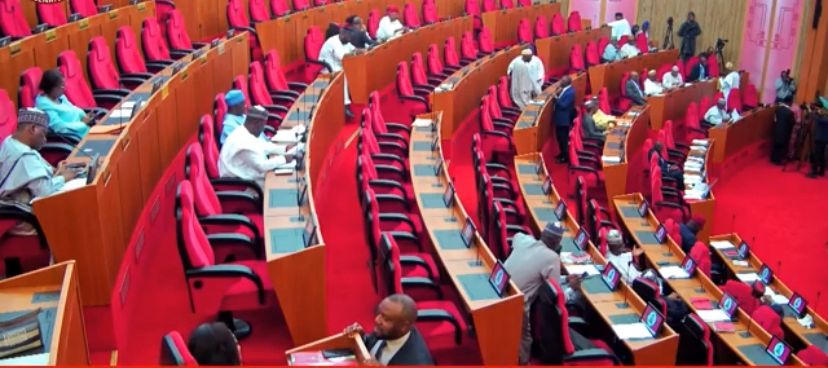
The Senate has suspended additional deliberation on the proposed amendments to the 2022 Electoral Act after a tense debate on Thursday uncovered sharp divisions amongst lawmakers over the extent and readability of the proposed reforms.
The choice adopted issues raised by Senate President Godswill Akpabio, who faulted the dearth of specificity within the draft modification and questioned the necessity for what he termed an “unclear repeal” of the prevailing Electoral Act.
The invoice, titled “A Invoice for an Act to Repeal the Electoral Act No. 13, 2022 and Enact the Electoral Invoice, 2025 to Regulate the Conduct of Federal, State and Space Council Elections within the Federal Capital Territory; and for Associated Issues (SB. 903),” seeks to switch the 2022 Act with a brand new authorized framework for managing elections in Nigeria.
Main debate on the overall ideas of the invoice, Chairperson of the Senate Committee on Electoral Issues, Simon Lalong (APC, Plateau South), defined that the proposal, first launched on 8 October, was not a mere modification however a full-scale reform geared toward modernising the nation’s electoral system.
Mr Lalong, a former governor of Plateau State, argued that the 2023 normal elections had revealed vital gaps in Nigeria’s democratic course of regardless of the positive aspects recorded below the 2022 legislation.
In keeping with him, Nigerians count on a “future-facing electoral legislation” that might deal with persistent challenges similar to delayed election funding, controversies over voter registers, ambiguities in end result transmission, and weak enforcement of electoral offences.
“The 2023 elections examined our democracy in profound methods,” he mentioned. “Nigerians count on not patchwork corrections however a holistic framework that restores religion within the course of.”
He famous that the proposed laws seeks to boost transparency, effectivity, and equity in elections, guarantee equal participation of political events, and strengthen the independence of the Independent National Electoral Commission (INEC).
Mr Lalong outlined a number of key improvements within the invoice, together with early launch of INEC funds, tenure safety for Resident Electoral Commissioners, steady voter registration, introduction of digital end result registers and QR-coded voter identification, and improved procedures for digital transmission of outcomes.
The invoice additionally prescribes stricter timelines for occasion primaries, clearer guidelines on candidate nominations, larger disclosure requirements for marketing campaign funding, and more durable penalties for electoral offences similar to vote shopping for and falsification of outcomes.
“This Invoice isn’t just about election day, it’s about strengthening the inspiration of our democracy,” Mr Lalong mentioned. “If we get it proper, we restore public belief and empower INEC to operate with out interference. If we falter, we danger perpetuating a cycle of contested elections and declining voter confidence.”
Akpabio raises objections
The talk turned contentious when Titus Zam (APC, Benue North East) moved that the invoice be learn a second time.
Mr Akpabio interjected, demanding readability on which provisions of the 2022 Act had been being repealed and what particular amendments had been being launched.
He questioned the committee’s presentation, saying senators should perceive “the nitty-gritty” of the proposals earlier than additional debate may proceed.
Mr Akpabio then veered into a private reflection on his expertise in the course of the 2019 Akwa Ibom North-West senatorial election, which he described as a case of unfair remedy.
He criticised INEC and the courts for what he referred to as the selective software of the legislation.
“The returning officer, Professor Peter Ogban, who served for 34 years, was wrongly sentenced to a few years in jail as a substitute of these really accountable for the electoral infractions,” he mentioned.
“If he was serving to me, how come my votes had been those affected?” Mr Akpabio queried.
He additional lamented the lengthy length of Nigeria’s electioneering cycle, saying extended campaigns and transition delays negatively have an effect on governance and cut back the efficient tenure of elected officers.
“We should have a look at the best way to stability between our electoral calendar and environment friendly governance,” he added.
Invoice stood down for additional clarification
Following Mr Akpabio’s objection, Senate Chief Opeyemi Bamidele (APC, Ekiti Central) moved that additional consideration of the invoice be suspended pending an in depth report from the Committee on Electoral Issues.
The movement was unanimously adopted by the chamber.
Consequently, legislative motion on the Electoral Act Modification Invoice, 2025, which, amongst different proposals, recommends conducting the 2027 presidential and governorship elections in November 2026, has been briefly halted.
Mr Akpabio dominated that the invoice wouldn’t return to the ground till senators are adequately briefed on the proposed adjustments and their implications for Nigeria’s electoral course of.
Recall that the Senate and Home of Representatives Committees on Electoral Issues had, earlier within the week, held a joint public listening to on the Electoral Act Modification Invoice, 2025.
The one-day session, chaired by Mr Lalong, offered a platform for lawmakers, civil society teams, political events, and authorized specialists to make submissions on key reforms forward of the 2027 normal elections.
On the listening to, each chambers of the Nationwide Meeting advocated shifting the presidential and governorship elections from February or March of the election yr to November of the previous yr.
In keeping with the draft proposal, the change is meant to permit sufficient time for transition planning, finances preparation, and determination of election disputes earlier than the inauguration of recent administrations.
By calculation, 185 days earlier than 29 Might 2027 falls round November 2026, implying that each the presidential and governorship polls for the 2027 cycle can be performed in that month.
Stakeholders on the listening to additionally canvassed statutory recognition of digital collation and transmission of outcomes, diaspora voting, stronger inner occasion democracy, and the institution of an Electoral Offences Fee to analyze and prosecute election-related crimes.
Broader electoral reforms
The proposed Electoral Invoice additionally goals to harmonise election timelines, strengthen INEC’s autonomy, and impose tighter controls on marketing campaign financing and political donations.
It supplies for digital end result administration, steady voter registration, and improved logistics for higher election-day efficiency.
READ ALSO: Invoice looking for to shorten election litigation timelines on track Lawmaker
A number of civil society teams current on the listening to urged lawmakers to make sure that the brand new legislation closes present loopholes, enhances transparency, and reduces post-election litigation.
Nevertheless, with Thursday’s determination to face down the invoice, consideration of those far-reaching reforms will stay on maintain till the Senate Committee on Electoral Issues submits an in depth report outlining every proposed change and its possible affect on the 2027 polls.
