


The primary a part of this sequence lined piracy and survival amongst Nigeria’s small-scale fishers and merchants. The second confirmed authorities inaction. This third instalment exhibits how shifting climate is battering artisanal fishers, as informed by way of the expertise of 1 group.
The fishermen in Ikuru – a small Andoni group on the coast of Rivers State, Nigeria – have so much to lament.
For generations, the settlement on the sting of the Atlantic lived by the tides. At daybreak, males paddled out in slender canoes whereas ladies waited ashore to purchase the day’s catch. The ocean offered sufficient to feed households and maintain the village.

It nonetheless does, however far much less reliably, particularly in some seasons.
On a latest, soggy afternoon, a dozen males and a girl sat on conventional benches underneath the sparse shade of bushes and shrubs rising from the white coastal sand, their eyes on the stressed sea. None had gone out to fish for days. The air hung heavy with moisture; the ocean waves crashed, retreated and gathered once more with nice pressure.
“It’s too harmful,” mentioned Fred Fred, the oldest amongst them, now in his seventies, who has fished right here since his youth.
Others nodded. The waters have turn into much less predictable, and venturing out might be deadly. “Individuals have died,” mentioned Nria Friday, a fish dealer, who arrived that morning however discovered no fish to purchase.


By their depend, six individuals have died this season alone whereas braving tough waters to seek out one thing to eat or promote.
“For those who go down there, you will note two our bodies,” Mr Friday mentioned, pointing to the east. “Individuals nonetheless need to attempt to get one thing.”
In Ikuru, the ocean used to have a rhythm. The August rains meant relaxation – a interval recognized amongst fishers as a time to restore nets and canoes whereas ready for the waters to settle.
“We might not go far,” Mr Fred recalled. “We caught fish close to the shore and waited for the water to be quiet.”
That rhythm has disappeared. Generally the wind and rain proceed for weeks longer than they used to. Storms now slam the shore with such pressure that paddling out a couple of metres might be harmful. “Even close to the shore, the waves are horrible, and (there are) no fish there,” Ete Joel, one other fisher, mentioned.

Fred Fred, forcing him to decide on between having no catch for weeks or risking his
small boat within the harmful, deeper ocean. Credit score: Ini Ekott)
As the boys spoke, a motorised boat appeared on the horizon. Two fishers fought the swells, their vessel rising and dropping sharply for a few quarter of an hour earlier than they lastly slid onto the sand, to the reduction of everybody watching.
Fred remembered a time when locals right here and in neighbouring Oyorokoto – reputed as the most important fishing settlement in West Africa – largely fished utilizing paddle boats. In these days, the seasons of heavy rains served one other objective: they allowed fish populations to regenerate as actions calmed.
Now, boats with highly effective engines push deep into the ocean all 12 months spherical. These missions, harmful throughout excessive storms and rains, depart no respiration area for the fish to replenish.
Males like Mr Fred, Mkpa-Teleyem Joel, Unyen-Awaji Nte and Michael Obi, who nonetheless depend on paddle boats or boats with weak engines, really feel doubly stranded – by the livid climate and by the relentless fishing of those that can nonetheless exit with motorised boats.
“Prior to now (even 20 years in the past), individuals averted the water this time due to dangers. Now, due to engines, they go any time, they usually run into dangers too,” mentioned Mr Nte.
“However their engine and the kind of internet some use additionally take an excessive amount of fish, and it’s an issue.”

Shrinking Inventory
Fish gives a few quarter of the animal protein Nigerians eat, and in coastal and riverine areas, it will probably supply up to 80 per cent. The common Nigerian consumes round 8 kg of fish per 12 months – far under the worldwide common of about 21 kg.
To fulfill a portion of this demand, Nigeria produces an estimated 1.1 million tonnes of fish yearly: 36 per cent from marine waters, 36 per cent from inland waters, and 28 per cent from aquaculture.
Lately, shifting climate patterns and rising water temperatures have affected fish survival, abundance, and migration, reshaping how fishers and merchants work. As ocean temperatures rise, fish transfer towards cooler waters.
The individuals of Ikuru don’t use the phrases “local weather change.” Nonetheless, what they describe aligns with what scientists say is unfolding alongside Nigeria’s southern coast.
Rainfall has turn into heavier and fewer predictable. Storms are extra extreme. And research exhibits that warming pushed by rising carbon emissions will sharply diminish world fisheries, with catches projected to fall by about 7.7 per cent and revenues by greater than 10 per cent by 2050.
The projections for West Africa are even grimmer. Research warn that waters alongside the equatorial stretch will expertise among the steepest declines, with Nigeria among the many most susceptible. Fish shares in Nigerian waters may drop by as a lot as 53 per cent – in contrast with losses of roughly 56 per cent in Côte d’Ivoire and round 60 per cent in Ghana.
Fishers say they already really feel the shift. Species not seem the place they as soon as did, rendering long-held information of the place and when to fish much less dependable. Many now journey farther offshore and spend extra on gas than they earn from their shrinking catches.
“With a great engine and gas, you may get sufficient fish. You’ll be able to go deep inside,” mentioned Ala Magnus, one other fisher.
Specialists say the group’s observations replicate broader scientific developments. Isangadighi Isangadighi, head of the Fisheries and Aquatic Environmental Administration Division on the College of Uyo, mentioned rising temperatures are disrupting fish copy and survival.
“The local weather has turn into unpredictable,” mentioned Mr Isangadighi, an affiliate professor who researches hydrobiology, fisheries, and biodiversity. “The temperature truly impacts the copy of fish. Prior to now, you could possibly predict at this level you’ll have so-so stage of copy… however when the temperature is fluctuating like that, you can not actually predict what’s going to occur.”
He defined that hotter waters include cascading issues. “Enhance in temperature can result in different issues. It might probably cut back the amount of dissolved oxygen. The upper the temperature, the decrease the oxygen,” he mentioned. Decreased water quantity from evaporation and better charges of fish spoilage – particularly for artisanal fishers with out correct storage – are additionally rising considerations.

fish throughout persistent rains, on account of violent storms and rising waves. They now
confront the hazard of fishing removed from shore. Credit score: Ini Ekott)
Loss of life on the Channel
Declining fish shares, shifting species, and harsher storms, mixed with piracy and crude-oil air pollution, are among the many greatest challenges dealing with small-scale fishers and merchants throughout Niger Delta communities
Additional east of Ikuru, some 172 kilometres away, fishers face one more weather-related downside that has gone unreported. At Ibeno in neighbouring Akwa Ibom State, they described a lethal slender channel on the mouth of the Qua Iboe River that connects to the Atlantic Ocean. Every wet season, sandbars choke this passage, inflicting boats to capsize.
This 12 months, 29 individuals have died on the Ibeno finish of the ocean, they informed us.
The deaths, locals say, are partly on account of siltation – the build-up of sand and sediment that has narrowed the channel over time.
“That one is a really significant issue for us in Ibeno,” mentioned Nduekiden Eshiet, an area chief. “We’ve known as on the federal government to assist take away the sand as it’s accomplished somewhere else. However no reply.”
The Akwa Ibom State Authorities, by way of its Ministry of Agriculture, which oversees the sector, didn’t reply to questions on insurance policies supporting the fishery subsector.
READ ALSO: How refinery and freeway venture worn out Akwa Ibom’s Stubbs Creek Forest
Battered by Air pollution
From Bori, a serious Ogoni city, the 43-minute journey to Ikuru cuts by way of among the area’s richest ecosystems – vivid farmland, swamp forests and a thick mangrove belt that deepens right into a lush, cinematic inexperienced.
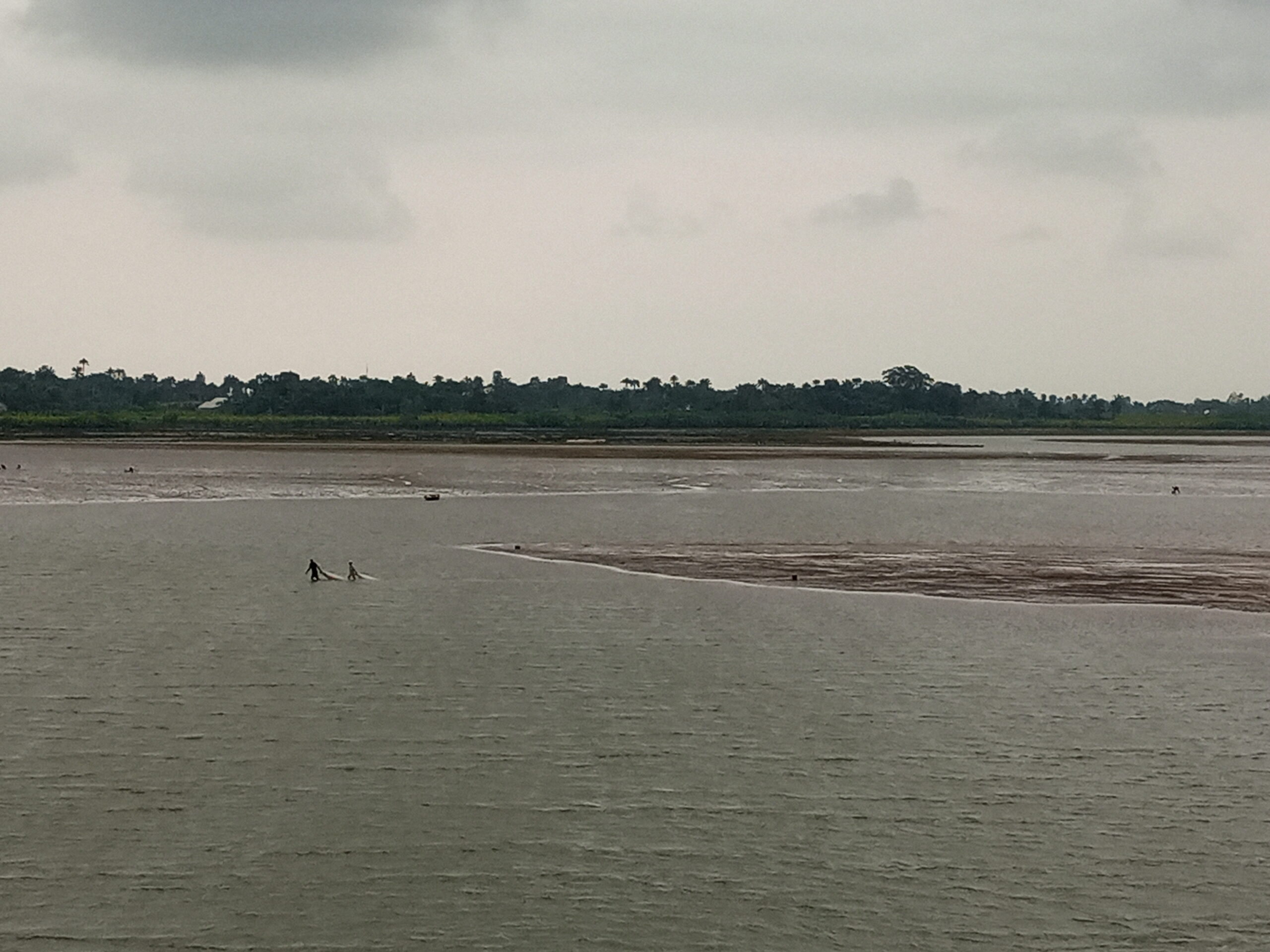
However the panorama retains breaking. Creeks alongside the route should not solely polluted, however many are additionally drying out. Massive stretches of sand now sit uncovered in the course of waterways, the place males wade throughout what was deeper channels to fish in ankle-deep swimming pools.
Oil air pollution provides its personal scars. Blackened mangroves, stagnant swimming pools and slicked surfaces seem repeatedly.
After a December 2024 spill from a Shell facility in Bonny unfold all the way down to Andoni’s Asarama, Oyorokoto and Agbama, fouling nets and boats, officers mentioned cleanup began quickly. However driving in direction of Ikuru, the indicators stay: oily surfaces, darkish mangroves and creeks, charred roots and darkish water.
Fishers in Ikuru mentioned their group has seen many adjustments, however they’re hopeful the catch will quickly be higher once more. Nobody, nevertheless, may inform when that shall be.
“For those who come again when we now have fish, we’ll have some for you,” Mr Fred informed the reporter who visited.
This story was supported by the Pulitzer Heart.
