


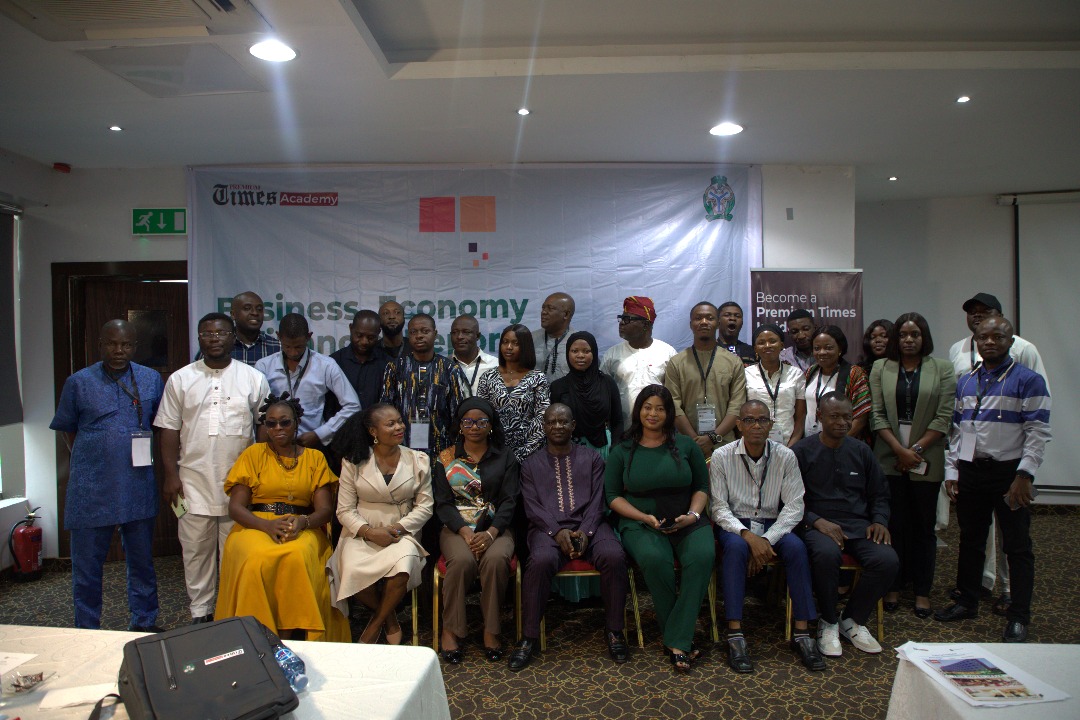
Premium Occasions Academy, the capability constructing arm of Premium Occasions Companies Restricted, has accomplished a two-day coaching of journalists from varied media retailers within the nation on enterprise, economic system and monetary reporting.
Held in Lagos between 26 and 27 November, the programme took contributors by means of reporting areas like financial coverage instruments and indicators, current reforms on the Central Bank of Nigeria (CBN), Nigeria’s financial system, open supply knowledge, fact-checking and verification instruments, amongst others.

The initiative was delivered by Premium Occasions Academy with help from the CBN, and centered on enhancing the abilities of Nigerian journalists in moral, data-driven and impactful reporting.
Facilitators ranged from monetary advisors and consultants to CBN officers and prime media practitioners.
The Abuja model of the coaching was held two weeks earlier. A complete of 25 journalists have been educated in the middle of the two-day programme.
Crafting knowledgeable tales
Ray Echebiri, the CEO of the Centre for Monetary Journalism, led the dialogue on how creating a deep understanding of the Nigerian monetary system may also help journalists write fact-based and correct tales which can be educative and interesting to the viewers.


“You need to have the ability to craft knowledgeable tales and evaluation in regards to the occasions within the system with a view to informing, educating and entertaining the viewers. That’s a very powerful factor we wish to obtain at this time,” he mentioned.
His session additionally dwelled on financial coverage, macroeconomic variables, banking regulation and operation in addition to the roles of regulatory our bodies within the Nigerian monetary system.
Entry to knowledge and authoritative reporting
Musikilu Mojeed, the editor-in-chief of PREMIUM TIMES shared with contributors assets for open-source knowledge than may be leveraged in enterprise, monetary and economic system reporting to boost tales.
The thrust of the session was the place of knowledge in incomes credibility and accuracy for brand spanking new tales, analyses and investigative studies.
Based on Mr Mojeed, monetary journalists should have ample entry to knowledge for them to report authoritatively on enterprise and financial issues.
“Each factor you write otherwise you do, the knowledge that you just present must be factual, must be correct, must be data-backed,” he mentioned.
“If you wish to analyse budgets, you need to have the ability to have a look at patterns, what has occurred, what sector previously 10 years is, what sector is getting extra, what sector is getting much less. You need to have the ability to have a look at that.”
He pointed reporters to the significance of aggregating knowledge and making an attempt to identify developments from them, which may also help in producing story concepts.
However he enjoined reporters to take the ache of building the unique sources of knowledge fairly than counting on secondary with the intention to keep away from misinformation and inaccuracies.
Knowledge evaluation and knowledge presentation
The necessity for journalists to keep away from telling the reality out of context was the main focus of the dialogue on knowledge evaluation and presentation, led by Zeal Akaraiwe, the CEO of Graeme Blaque Advisory.

He inspired reporters to all the time take into account each facet of the topics they’re reporting in different to realize truthful, balanced and goal reporting in such a manner that no a part of the story is disregarded.
“Lots of reforms are being executed on the CBN. The way in which journalists select to current it will probably make a world of distinction,” he mentioned.
Mr Akaraiwe remarked that the media has an obligation to make use of its energy, backed with knowledge and correct evaluation, to carry governments accountable.
Moral rules and requirements
Mr Mojeed drew contributors’ consideration to the crucial of sustaining excessive code of conduct and normal of behaviour that adhere to world finest practices within the discipline of journalism.
He highlighted key qualities that reporters must embrace, together with truthfulness, accuracy, objectivity, impartiality and equity.

The PREMIUM TIMES’ editor-in-chief inspired contributors to get a replica of Code of Ethics for Nigerian Journalists (1998), which is out there in digital format.
He lamented the truth that many reporters across the nation are usually not conversant in the code of ethics of the career, but practise journalism.
“How do you observe a career whose ethics you aren’t conversant in?” he requested.
Based on him, it’s morally crucial for all journalists and media organisations to uphold the best skilled and moral requirements within the conduct of their responsibility and to even have excessive regard for public curiosity.
“The general public has a proper to know factual correct, stability and truthful reporting. That is the final word goal of fine journalism and the premise of getting public belief and confidence,” he mentioned.
Countering disinformation with fact-checking
David Ajikobi, the Nigeria Editor at Africa Verify, highlighted methods that might be employed in countering disinformation and for checking the accuracy of claims already in public area.
Mr Akinjobi said that contributors want to know that journalists themselves could be a goal of disinformation and misinformation.

He enjoined contributors to keep away from bias in all its kinds of their reporting.
“At all times ask your self, ‘Am I goal?’ Typically even your objectivity is perhaps biased. Am I giving all sides to the story? Typically even giving all sides to story may not be I don’t test all of the details, whether or not I personally agree with them or not,” he mentioned.
Based on him, any hole in an enormous story is a possible device for disinformation.
CBN as lender of final resort
Fidelis Odia, a deputy director on the CBN who represented Akinwunmi Olubukola, the CBN’s director of banking supervision, supplied insights into the capabilities and construction of the banking trade regulator.
His presentation centred on the CBN’s regulatory roles in addition to its financial and monetary stability capabilities, financial coverage, threat administration and overseas trade administration.

Mr Odia highlighted the importance of the CBN within the financial economic system, among the current developments within the trade and the continuing recapitalisation of banks within the nation, which is geared toward supporting the push for a $1 trillion economic system.
It’s a main position of the central financial institution “to make sure that the banks are adequately capitalised. Capital is the life-wire of any establishment,” he mentioned.

“Liquidity is there, however capital is the primary factor, as a result of capital offers buffer to soak up losses. So if it’s not there, what occurs is the establishment can go below, and we would like our establishment to be sturdy,” he added.
